
On this page
The quick checklist
| Sign | Repair | Replace |
|---|---|---|
| One corner or end cap drips | Yes | |
| Many seams leak along the house | Yes | |
| One run sags | Yes | |
| Several runs sag, spikes everywhere | Yes | |
| Outlets clog with needles | Yes, larger outlets or guards | |
| Rust or splits in several places | Yes | |
| Fascia soft in one spot | Yes | |
| Fascia rotten along most of the eave | Yes | |
| One section bent by a limb | Yes | |
| Most runs damaged in a windstorm | Likely | |
| Overflow everywhere when clean | Yes, upsize | |
| Re-roofing | Usually |
When repair makes sense
Repair is the right call when the problem is local and the rest of the system is sound:
- Leaking corners resealed or replaced.
- A sagging run re-hung on hidden hangers.
- Needle-clogged outlets cleared and enlarged.
- A crushed downspout replaced.
- A section of rotten fascia cut out and replaced.
- Wind damage to one or two sections.
When replacement makes sense
Replacement is the better choice when:
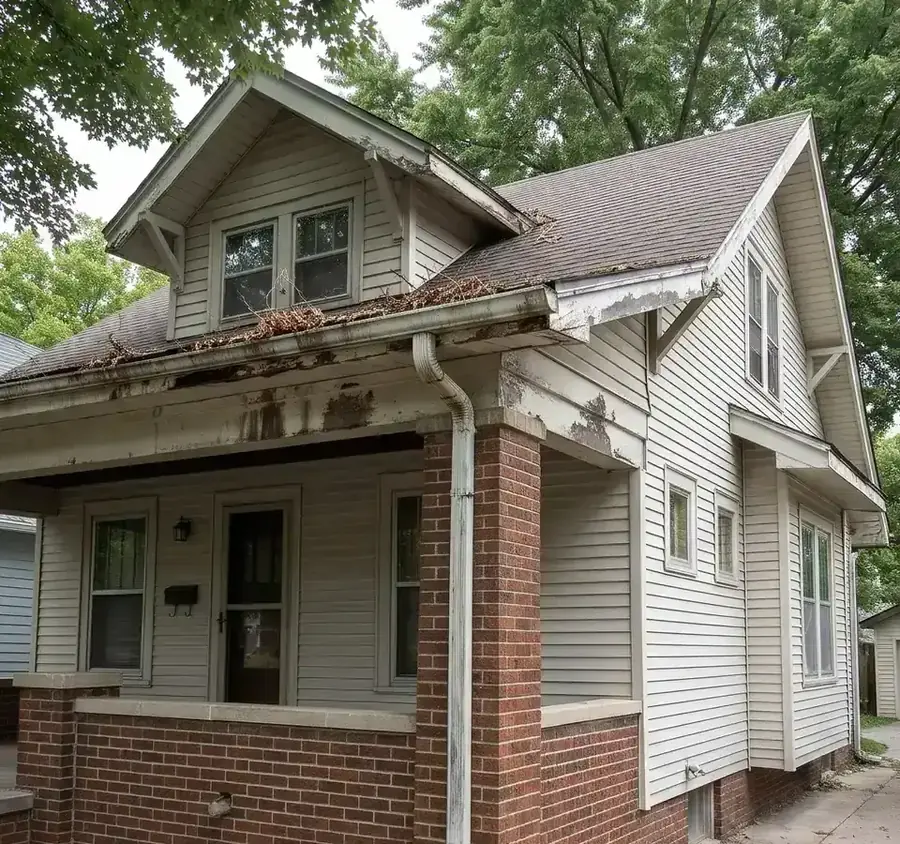
- The gutters are sectional and leak at many seams. Each seam will fail in turn, and in Seattle each one drips through months of rain.
- They are rusting or splitting. Old steel rusts from the inside, and thin aluminum splits at corners.
- They sag in several places, especially on spikes and ferrules.
- The fascia is rotten along much of the eave. The gutters must come down anyway.
- The system is too small or its outlets too small for the trees above.
- You are re-roofing. New drip edge and gutters go on together.
- Wind damage is widespread.
The cost over a few years
A single repair is cheap. Angi puts the national average gutter repair at about $390, and small jobs sit well below that. But a failing sectional system tends to need one repair after another. If you are calling every season for a different seam or a different sagging run, the total soon approaches the cost of seamless replacement, which national guides put at about $9 to $13 a foot installed.
A worked example
Here is an illustration. A two-storey house in Ravenna has 1980s sectional gutters under big trees. The owner has paid for three repairs in four years: two leaking seams and a sagging run. Now another run sags and the fascia behind it is soft. Each repair was well below the national average, but together they add up, and the system is still failing. Replacing with seamless 6-inch gutters, fixing the fascia and adding larger outlets makes more sense than a fourth repair.
Timing in Seattle
Seattle's dry season is short. Sea-Tac averages about 5 days with measurable rain in July and August, and around 14 in October. A repair can wait for a dry spell; a replacement is best booked for late spring to early fall, so the new system is in before the wet season.
Questions to ask yourself
- How many places are failing, and is it getting worse?
- Is the fascia sound behind most of the gutter?
- Do the gutters overflow when clean?
- Are you planning a new roof in the next few years?
- Has a windstorm damaged most of the system?
- Do the downspouts carry water away from the foundation and off any slope?
What a contractor should tell you
A good contractor will say plainly whether a repair will last, and why. Ask what caused the problem, whether it will happen elsewhere on the house, how long the repair should last, and what replacement would cost. Check the contractor's registration with L&I's Verify tool.
A rule of thumb
If one or two things are wrong and the rest of the system is sound, repair. If problems are spread across the house, keep coming back, or are rooted in the gutters being the wrong size or type, replace.