
On this page
What wind and trees do to gutters
| Damage | Cause | What to look for |
|---|---|---|
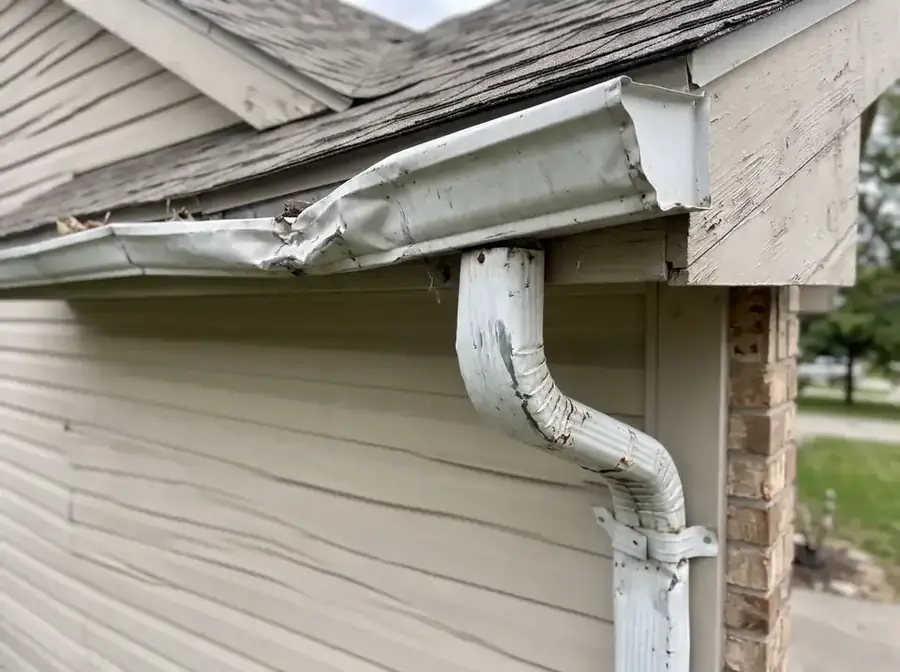
| Bent or kinked runs | Falling limbs, ladders during clean-up | A visible kink that holds water |
| Crushed downspouts | Limbs, wind-blown debris | Flattened or split sections |
| Torn hangers | Limbs, wind, a gutter full of wet debris | Gutter leaning out or dropping |
| Gutter pulled off | Large limb or tree | Sections hanging or on the ground |
| Damaged fascia and roof edge | Any of the above | Cracked boards, lifted shingles, missing drip edge |
| Dents | Cones, small branches | Dents along the front face holding water |
Seattle's windstorm history
Seattle's big storms are windstorms, and most of their damage comes from trees:
- December 14–15, 2006. The Hanukkah Eve windstorm cut power to more than 175,000 Seattle City Light customers, 45 percent of the system, as trees crashed onto lines across the region. It took 11 days to restore power to all customers in western Washington, and more than 1.8 million homes and businesses across the Pacific Northwest lost power.
- November 19, 2024. A bomb cyclone brought gusts of nearly 60 mph and left more than 114,000 City Light customers without power, the utility's largest outage since 2006. The northern neighborhoods and the cities of Shoreline and Lake Forest Park were hit hardest. The winds came from the east, the opposite of the usual direction, which made trees easier to knock down; trees fell across 15th Avenue NE in Maple Leaf and Beacon Avenue South.
Smaller storms bring branches down most winters. Houses under tall firs and big-leaf maples see the most damage.
What to do after a windstorm
- Stay safe. Keep at least 30 feet from downed power lines and call 911. Report outages to Seattle City Light on (206) 684-3000. Keep people away from hanging gutters.
- Report blocked streets. Trees or slides blocking a street go to SDOT on (206) 684-7623.
- Photograph everything. Gutters, downspouts, fascia, the roof edge and any fallen limbs, from several angles, before anything is moved. Note the date.
- Prevent further damage. If water is getting into the house, temporary measures such as a tarp are reasonable; keep receipts.
- Call your insurer before signing any repair contract, and ask what they need.
- Get an inspection and written estimate from a registered contractor who checks the gutters, fascia and roof edge.
Checking contractors after a storm
After big storms, demand for repairs spikes. Washington requires every construction contractor to register with L&I and carry a bond and insurance. Look up anyone you are considering in L&I's Verify a Contractor tool, and expect a signed Notice to Customer before work starts on any home job of $1,000 or more. Anyone doing business in Seattle also needs a Seattle business license tax certificate.
How storm repairs are done
- Bent sections are replaced; heavily damaged runs are often replaced whole.
- Torn hangers are replaced with hidden hangers screwed into solid wood.
- Crushed downspouts and elbows are replaced and strapped to the wall.
- Damaged fascia is cut out and replaced before the gutter is re-hung.
- The roof edge is checked for lifted shingles and damaged drip edge.
If several runs are damaged, replacement with heavier coil may be the better option, and the moment to fix undersized outlets at the same time.
Insurance
Sudden damage from wind or a falling tree is often covered by homeowners insurance, subject to the deductible; gradual wear, clogs and rot generally are not. A written estimate that describes the storm damage, with photos, helps the claim. Seattle's hazard plan also notes that ordinary homeowners policies do not cover landslide damage. This page is general information, not insurance advice.
Related pages
- Gutter repair
- Fascia and soffit repair
- Gutter replacement
- Aluminum gutters in heavier coil