
On this page
What are seamless gutters?
Seamless gutters are formed on site from a roll of aluminum, steel or copper coil and cut to the exact length of each eave, so a straight run has no joints. The only seams are at the corners, end caps and downspout outlets. Fewer joints mean fewer places for sealant to dry out and leak, which is the main reason seamless has replaced sectional gutters on most Seattle houses.
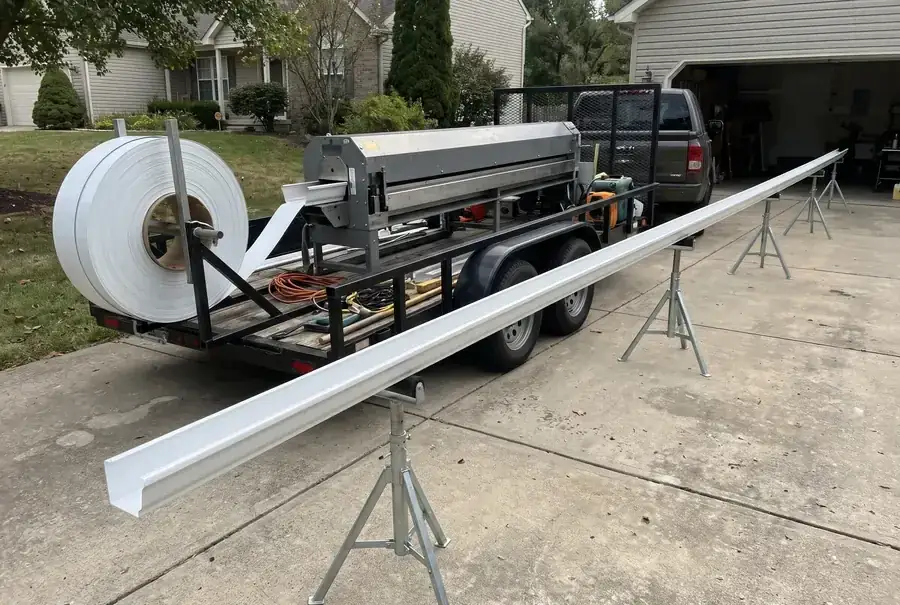
The installer parks a forming machine beside the house, feeds coil through it, and the machine rolls the profile and pushes out a gutter as long as the eave. Each piece is carried to the ladder, hung on hidden hangers, and joined to its neighbors only where the roof line turns a corner. On tight city lots, the crew may form runs in the street or driveway and walk them in.
Seamless vs sectional gutters
| Seamless | Sectional | |
|---|---|---|
| Joints | Only at corners, ends and outlets | A seam every 10 feet or so |
| Leaks | Far fewer places to fail | Each seam's sealant ages and cracks |
| Installation | Formed on site by a contractor | Pre-cut lengths, often DIY |
| Appearance | Clean continuous lines | Visible seams along each run |
| Cost | National guides: about $9 to $13 a foot installed for aluminum | Cheaper materials; similar labor if professionally hung |
Read seamless vs sectional gutters for more detail.
Why seamless matters in Seattle
Seattle's rain is not usually torrential, but it is persistent. Measurable rain or snow falls on about 156 days a year, and from November through January on around 18 or 19 days a month. A sectional gutter with a weak seam does not just leak in a storm; it drips almost every day for half the year, onto the same spot of fascia, siding or foundation. With seamless runs, the only joints left are the corners and outlets, and those can be strapped, riveted and sealed with care.
Seamless runs also resist the slow damage of debris. Needles and moss collect at seams in a sectional gutter, holding water against the sealant. A continuous trough flushes more cleanly toward the outlet and is stiffer between hangers under the weight of wet needles.
Sizes and profiles
- 5-inch K-style is the standard on many smaller houses and single-storey roofs.
- 6-inch K-style carries more water and pairs with 3x4 downspouts, whose larger outlet is far harder for needles to block.
- Half-round can also be formed seamless on some machines, and suits Craftsman and Tudor houses.
Materials
Most seamless gutters in Seattle are aluminum, which does not rust and is easy to form. Heavier coil, such as .032 inch rather than .027, resists dents from falling limbs and ladders, and is worth asking about under big trees. Seamless steel and copper are also available from some contractors.
What a good seamless installation includes
- Every run measured on site, including corners, outlets and any changes in roof line.
- Fascia checked and soft wood replaced before anything is hung.
- Hidden hangers screwed into solid wood, typically every 2 feet or closer under heavy trees.
- Even pitch to each outlet, with no low spots where water and needles sit.
- Corners mitered, strapped and sealed; end caps crimped and sealed.
- Outlets cut cleanly with downspouts fastened to the wall.
- Downspouts that discharge away from the foundation and off any slope.
- Water test with a hose before the crew leaves.
Cost
National guides put seamless aluminum at about $9 to $13 a foot installed, with 6-inch about 50 cents to $1 a foot more. A house with 150 feet of gutter might land somewhere around $1,350 to $1,950 before downspouts, removal and any wood repair, and Seattle-area labor often sits toward the top of national ranges. That is a rough national figure, not a quote. See the Seattle gutter cost guide.
Related pages
- Gutter installation for every material and size
- 6-inch gutters for bigger roofs
- Gutter replacement for old sectional systems
- Gutter guards to fit at the same time