
On this page
What are half-round gutters?
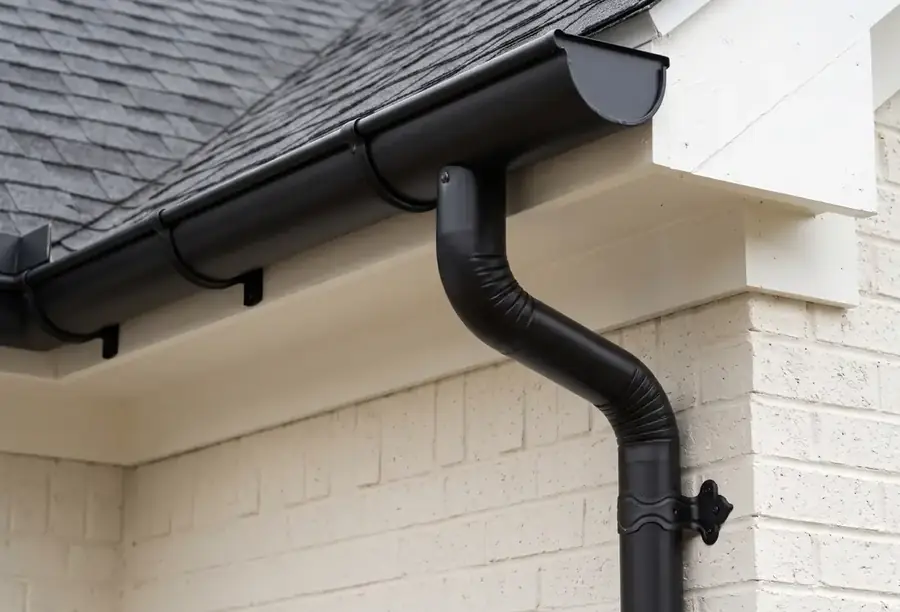
Half-round gutters are shaped like a pipe cut in half lengthwise. They hang on round brackets, drain through round downspouts, and give a softer, more traditional roof line than K-style. Before K-style became common in the mid-twentieth century, half-round was the standard profile in much of the country, and many older Seattle houses were designed with that look.
Where half-round suits Seattle houses
Half-round looks right on:
- Craftsman bungalows in Wallingford, Beacon Hill, Columbia City and Montlake, many with exposed rafter tails.
- Tudor-style houses, with steep gables, in Montlake and the lake neighborhoods.
- Older homes on Capitol Hill and Queen Anne.
- Brick and stone houses anywhere that suit a traditional profile.
Half-round vs K-style
| Half-round | K-style | |
|---|---|---|
| Shape | Semicircle on brackets | Flat back, ogee front |
| Capacity for same width | A little less | A little more |
| Downspouts | Round | Rectangular |
| Look | Traditional, soft | Modern, crisp |
| Debris | Smooth trough flushes needles easily | Corners hold debris |
| Cost | Usually higher | Usually lower |
Sizing half-round for Seattle
Because a half-round trough holds a little less than K-style of the same width, it is often sized up: 6-inch half-round in place of 5-inch K-style, with 3- or 4-inch round downspouts. In Seattle, the bigger concern is the outlet. Fir and cedar needles fall year round, and a small round outlet can plug. With rain on about 156 days a year, a plugged outlet means overflow on many days. A larger outlet and, under conifers, a micro-mesh guard made for half-round keep it flowing.
Materials
- Aluminum half-round keeps the look at lower cost and comes in painted colors.
- Copper half-round is the classic choice on historic houses and lasts for decades. National guides put copper at about $15 to $40 a foot installed. Keep zinc-based moss treatments off it; zinc corrodes copper.
- Galvanized or painted steel is strong but needs its coating intact to resist rust in a wet climate.
Brackets and fastening
Half-round gutters hang on round brackets. Fascia brackets screw to the face of the fascia board. Shank brackets attach to the roof deck and are best fitted when the roof is being replaced. On Craftsman houses with exposed rafter tails and no continuous fascia, rafter brackets fasten to each rafter. Bracket spacing should be close enough to carry a gutter full of wet needles and moss, and to stay put when a windstorm brings branches down.
Older houses and repairs
On older houses, the wood behind or under the gutter often needs attention first. Rafter tails exposed to decades of Seattle rain can be soft at the ends, and painted fascia can hide rot. A contractor who works on older houses will check and repair the wood before hanging new half-round, and can explain whether a landmark district review applies.
Half-round on Seattle's older houses
Half-round gutters were the standard profile before K-style became common in the mid-1900s, so they suit many of Seattle's early-1900s houses. Neighborhoods with a lot of period housing, such as Capitol Hill, Montlake, Wallingford and Columbia City, are where owners most often ask for them.
| House style | Why half-round suits it |
|---|---|
| Craftsman bungalow | Round profile and brackets work with exposed rafter tails |
| Tudor revival | Copper half-round matches steep gables and masonry |
| Victorian and Queen Anne style | Original houses often had half-round or built-in gutters |
| Brick and stone houses | Copper half-round is a traditional pairing |
Capacity and needles
A half-round gutter carries less water than a K-style gutter of the same width, because its rounded bottom holds less. On large or steep roofs, a 6-inch half-round or extra downspouts make up the difference. Round downspouts on half-round systems are often 3 or 4 inches across; larger round outlets pass fir needles more easily than small ones. Under conifers, micro-mesh guards made for half-round profiles keep the trough clear.
Brackets and fascia
Half-round gutters usually hang from brackets fixed to the fascia or roof deck, rather than hidden hangers inside the gutter. Brackets should be spaced closely enough to carry wet needles and moss without sagging, and fixed into sound wood. On houses with exposed rafter tails, brackets can be fixed to the tails themselves.
Material choices
Aluminum half-round is the budget choice and comes in colors to match the trim. Copper half-round lasts for decades and weathers to brown and green. Oregon State University Extension warns that zinc moss products corrode copper, so choose copper-safe moss treatments if you go that way.
Related pages
- Copper gutters
- Gutter replacement on older houses
- Downspouts
- Aluminum vs steel vs copper