
On this page
Side by side
| Aluminum | Steel | Copper | |
|---|---|---|---|
| National installed cost | About $9 to $13 a foot | About $8 to $13 a foot | About $15 to $40 a foot |
| Rust | Does not rust | Rusts once coating is scratched | Does not rust; patinas |
| Dent resistance | Fair to good, depending on coil | Very good | Good |
| Weight | Light | Heavy | Moderate |
| Seamless on site | Yes | Some contractors | Some contractors |
| Colors | Many | Several | Natural copper |
| Joints | Sealed | Sealed | Soldered |
| Lifespan | Around 20 years or more | Varies with coating | Many decades |
Aluminum
Aluminum is the default for a reason. It does not rust, it is light enough to be easy on fascia, it forms seamless on site, and it comes in dozens of baked-on colors. The thing to ask about is coil thickness. Thin coil dents under a ladder or a falling branch and sags under wet needles; .032-inch coil is much tougher. In neighborhoods under big trees, the extra cost is worth it. See aluminum gutters.
Steel
Steel, usually galvanized or Galvalume with a painted finish, is stronger than aluminum and resists dents from limbs. Its weakness is rust: once the coating is scratched, by a ladder, a branch or a cleaning tool, rust starts and spreads. In a climate with rain on about 156 days a year, and with wet needles sitting in the trough for months, steel needs its coating kept intact. Steel is also heavier, so hangers and fascia need to be sound.
Copper
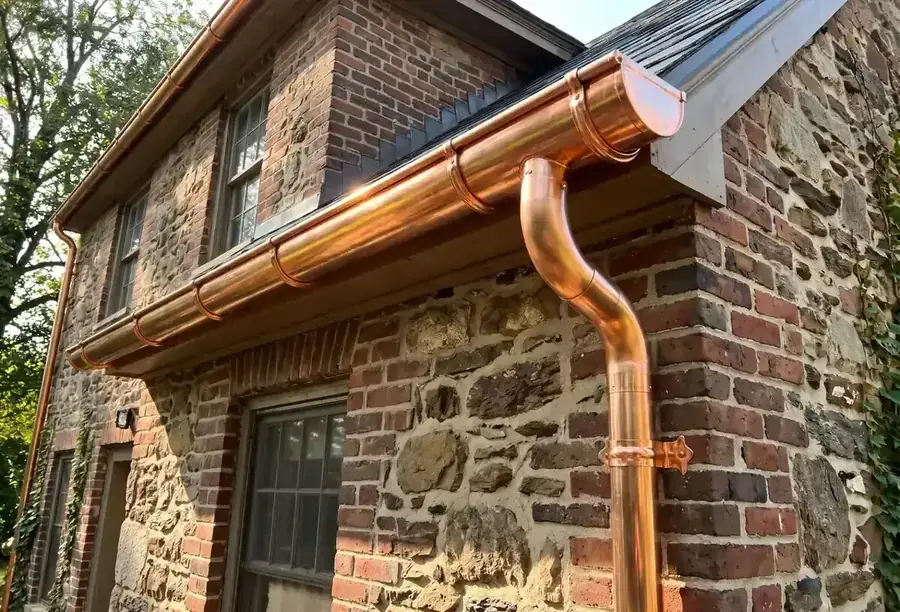
Copper lasts for many decades, its joints are soldered for a lasting seal, and it weathers to brown and then green. It costs several times more than aluminum, so it is usually reserved for houses where looks and longevity justify it. Seattle has many such houses: Capitol Hill, Montlake, Queen Anne, the lake neighborhoods, and brick and stone houses across the city. See copper gutters.
The Seattle catch is moss. Many moss treatments contain zinc, and Oregon State University Extension warns that zinc corrodes copper gutters, downspouts and flashing. If you choose copper, choose a copper-safe moss treatment or remove moss by hand.
Matching material to the house
| House | Usual choice |
|---|---|
| Craftsman bungalow or Seattle box house | Seamless aluminum, or half-round aluminum or copper |
| Two-storey house or remodel | Seamless aluminum, 6-inch, heavier coil |
| House under big firs and cedars | Heavier aluminum coil, with micro-mesh guards |
| Modern townhouse | Aluminum in black or dark grey, or box gutters |
| Tudor, brick or stone house | Copper or aluminum half-round |
| Church or historic commercial building | Copper, or heavy box gutters |
Seattle factors
Wet debris. Needles and moss hold water against the metal for months. Aluminum and copper tolerate it; steel with scratched coating does not.
Wind and limbs. Seattle's big windstorms, such as the Hanukkah Eve storm of 2006 and the 2024 bomb cyclone, bring down branches. Heavier aluminum, steel and copper all handle that better than thin aluminum.
Moss treatments. Read the label before using any moss product on a roof with metal gutters, and never use zinc near copper.
Do not mix copper with other metals
Copper and aluminum, or copper and steel, corrode where they touch in the presence of water. If copper gutters are installed, flashing, fasteners and brackets must be copper, brass or stainless steel. Water running off a copper roof feature onto aluminum gutters causes the same problem.
A worked example
Here is an illustration, not a quote. A 150-foot job priced at the national ranges would come to roughly $1,350 to $1,950 in seamless aluminum, $1,200 to $1,950 in steel, and $2,250 to $6,000 in copper, before downspouts, removal and wood repair. For most Seattle houses, aluminum in heavier coil gives the best balance.
Our short answer
For most Seattle houses, seamless aluminum in heavier .032 coil with 3x4 downspouts is the best balance of cost, durability and needle resistance. Choose copper for period or high-end houses where looks and longevity matter, and keep zinc moss products away from it. Choose steel only where dent resistance is the overriding concern and the coating can be kept intact.