
On this page
Where gutters leak
| Where | Why | Usual fix |
|---|---|---|
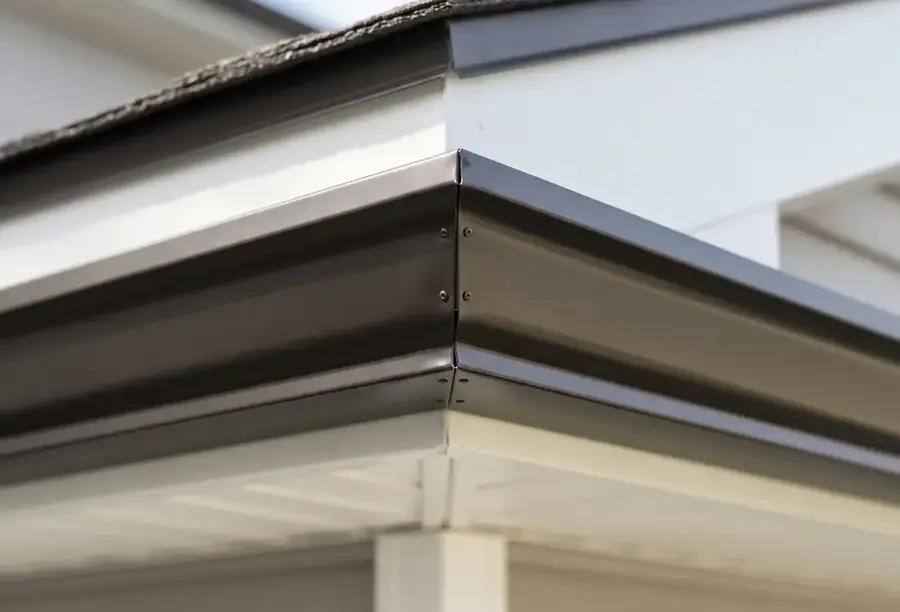
| Inside and outside corners | Dried or cracked sealant, split miter | Reseal or replace the corner |
| End caps | Sealant failure, loose crimp | Reseal and re-crimp, or new end cap |
| Seams on sectional gutters | A joint every 10 feet or so, each one ageing | Reseal; replace if many fail |
| Downspout outlets | Loose or poorly sealed outlet | Reseal or replace the outlet |
| Holes in the trough | Corrosion under wet debris, old nail holes | Patch small holes; replace the section if badly corroded |
| Behind the gutter | No drip edge, gutter hung too low | Fit drip edge, re-hang the gutter |
Why small leaks matter more in Seattle
In a city with rain on about 156 days a year, a drip at a gutter corner is not an occasional nuisance. From November through January there are around 18 or 19 rainy days a month, and the same corner drips onto the same spot of fascia, siding or foundation almost daily. Painted wood stays wet, rot starts behind the paint, and stains spread down brick and siding.
Debris makes it worse. Needles and moss collect in corners and against seams, holding water against the sealant and keeping the metal wet, which speeds corrosion on older steel gutters.
How a leak repair works
- Find the leak. The contractor runs water through the gutter with a hose and watches where it comes out.
- Clean the joint. Old sealant, debris and corrosion are removed back to bare metal.
- Dry and reseal. A gutter-grade sealant is applied inside the joint, and loose rivets or screws are replaced. In Seattle that often means waiting for, or creating, a dry window.
- Replace what cannot be saved. Split corners, failed end caps and corroded sections are cut out and replaced.
- Check the pitch. If water was pooling at the leak, the run may need re-hanging so it drains.
- Test again. Water should run to the outlet with no drips.
Leaks that are not really leaks
Some drips are something else:
- Overflow. A plugged outlet sends water over the front edge. That is a moss and needle clog, not a joint problem.
- Water behind the gutter. If the drip comes from the back of the gutter, water may be running down the fascia because drip edge is missing.
- Downspout joints. Water pouring out halfway down the wall is a downspout repair issue.
When to replace rather than reseal
Resealing makes sense for a few joints. If you have old sectional gutters leaking at many seams, corroded steel, or corners that have been resealed several times, seamless replacement usually costs less over time. See repair or replace.
Cost
Small repairs are inexpensive; bigger ones add up. Angi puts the national average for gutter repair at about $390. Resealing a corner or end cap sits well below that. Replacing a split miter, adding drip edge along a run, or replacing corroded sections costs more. These are national figures; the contractor's quote is the real number.
Finding the leak
Leaks are easiest to find in the rain, or with a hose run into the gutter on a dry day. Look for:
| Where it drips | Likely cause |
|---|---|
| At a regular spacing along the run | Sectional seams |
| At a corner | Failed miter sealant |
| At the end of a run | Loose or unsealed end cap |
| At the downspout | Outlet not sealed to the gutter |
| Behind the gutter, down the fascia | Missing drip edge, or gutter pulled away from the wall |
| Over the front in rain | Not a leak: a clog, or the gutter is too small |
Why leaks matter more in Seattle
A seam that leaks in a storm somewhere drier drips on most days here from October to April. Sea-Tac averages around 18 or 19 rain days in November through January. Steady dripping onto the same spot rots fascia, stains siding, and soaks the soil at the foundation. Fixing a leak early is cheap; fixing the wood behind it later is not.