
On this page
A schedule by tree type
| Trees near the roof | How often | When |
|---|---|---|
| None | Once a year | Early fall |
| A few broadleaf trees | Twice a year | Late fall after leaf drop; spring |
| Big-leaf maples or alders overhead | Twice, sometimes three times | Late fall; spring; early fall if seeds and catkins are heavy |
| Firs, cedars, pines or hemlock overhead | Three to four times | Early fall; late fall; late winter; spring |
| Mix of conifers and maples | Three to four times | As above, timed around leaf drop |
Why Seattle needs more cleaning than most places
Conifers drop needles all year. Fir and cedar shed needles in every season, so a house under them fills its gutters slowly but constantly. Seattle's canopy covered about 28 percent of the city in 2021, much of it evergreen.
Moss. Oregon State University Extension notes that moss on roofs is inevitable in the moist Pacific Northwest. Clumps wash into the gutters and plug the outlets.
Shade slows drying. OSU Extension also notes that trees that shade the roof slow its drying and recommends cleaning gutters before the fall rains, because clogged gutters back water up under the lowest course of the roof.
Rain on most days of the wet season. Sea-Tac averages around 18 or 19 days with measurable rain in November, December and January. A clog that forms in October overflows for months.
Best months
- September to early October. Before the wet season starts, clear summer debris and check the outlets.
- November to December. After the big leaf drop, clear maples, alders and needles.
- February to March. Clear winter needles, cones and moss, and storm debris.
- May to June. Clear catkins, seeds and spring needle fall on heavy-tree lots.
The driest stretch is summer, with only about 5 days of measurable rain in July and August. That is a good time for repairs, re-hanging and guards.
Warning signs between cleanings
- Water spilling over the front of the gutter in rain.
- Downspouts that barely trickle in a downpour.
- Plants, moss or seedlings growing in the gutter.
- Gutters pulling away or sagging.
- Water stains or green streaks on siding.
- Wet soil, splashback or puddles at the foundation.
- Drips inside at the top of a wall or around a window.
What a proper cleaning includes
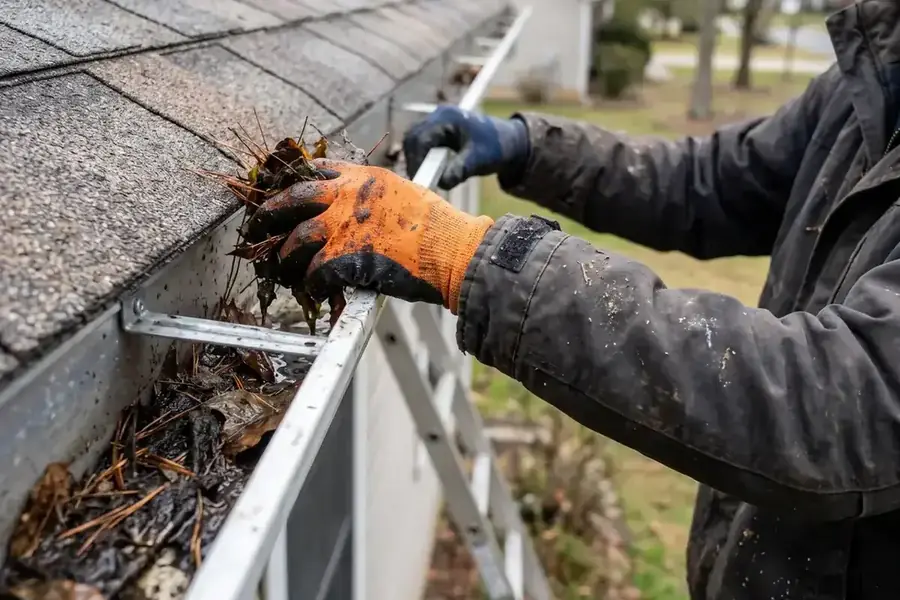
- Remove debris from the gutter by hand or scoop.
- Clear each outlet and flush each downspout until water runs freely.
- Check underground connections where downspouts go into drain lines.
- Look for loose hangers, leaking corners and soft fascia.
- Clear debris from the roof surface near the gutters.
- Bag and haul away debris.
Cost
National guides put a professional gutter cleaning at about $167 on average, with HomeAdvisor's range at about $119 to $235. Two-storey houses, steep roofs and heavy needle loads cost more. If you are paying for three or four cleanings a year, compare that with gutter guards.
Doing it yourself
On a single-storey house with a dry day and a sturdy ladder, many owners clean their own gutters. On two- and three-storey houses, steep roofs, or wet days, hiring a crew is safer. Never work near power lines; Seattle City Light advises staying at least 30 feet from downed lines, and ladders should be kept well clear of overhead service wires.
Cleaning and the roof
Gutter cleaning is a good time to look at the roof edge. Oregon State University Extension notes that clogged gutters can back water up under the lowest course of shingles and that moss can loosen granules on asphalt shingles. A crew clearing gutters can spot curled shingles, missing drip edge, moss build-up and soft fascia, all of which are cheaper to fix early.